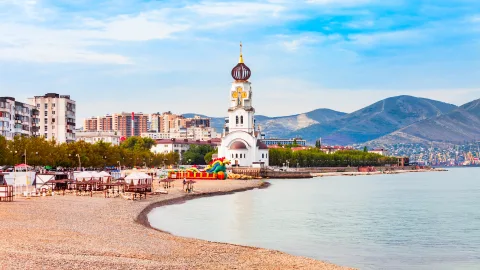
Egypt on the Mediterranean — it sounds unusual, but that's exactly what El Alamein looks like: white sand, turquoise water, and 82°F instead of the Red Sea's punishing 108°F. A resort most Russians haven't discovered yet has already become the main summer destination for Egyptians themselves.
In the popular imagination, Egypt means Hurghada, Sharm el-Sheikh, and Red Sea coral reefs. El Alamein breaks that mold entirely: no coral, no year-round season, and none of the punishing heat Egypt is known for.
What it does have is the Mediterranean Sea, sandy beaches that don't require reef shoes, and a summer climate closer to Greece than desert. Here's when to go, and what you get in exchange for skipping the usual Hurghada trip.
Where It Is, and What "New Alamein" Actually Means
El Alamein sits on Egypt's northern coast, roughly 100 kilometers west of Alexandria. Most people recognize the name from a different context: this is where one of the pivotal battles of World War II was fought in 1942. Military memorials and cemeteries still line the road today.
But the tourist-facing El Alamein isn't the old town near the memorials — it's New Alamein, an ambitious development Egypt has been building since 2018.
Skyscrapers, marinas, promenades, golf clubs — the government is pouring billions into creating a world-class Mediterranean resort. Some of the infrastructure already operates; some is still under construction.
Two Seas, Two Different Kinds of Vacation
The key thing to understand before choosing: the Red Sea and the Mediterranean are two fundamentally different formats.
The Red Sea (Hurghada, Sharm) runs a year-round season. Water sits at 72–82°F (22–28°C) in any month. Coral reefs line the shore, and the underwater world ranks among the best on the planet. But summer brings 104–113°F (40–45°C) air — dry, suffocating heat.
The Mediterranean (El Alamein) runs a season from May through October — winter is too cool for swimming. There's no coral, minimal underwater life. What it does have is sandy beaches with a gentle entry, turquoise water, and summer temperatures running 9–14°F cooler than the south.
Weather Month by Month
- January–March. Air at 57–68°F (14–20°C), water at 61–64°F (16–18°C). Swimming's off the table, but fine for sightseeing and walks. Sunny days, cool nights. Low season — most beach hotels run at reduced capacity.
- April. Transitional: air at 70–75°F (21–24°C), water at 64–68°F (18–20°C). Already warm, but the sea still bites. The boldest start swimming by month's end.
- May. Season starts. Air at 77–82°F (25–28°C), water at 70–73°F (21–23°C). Comfortable for adults, kids may find it cold. Fewer tourists, prices below peak.
- June–August. The peak. Air at 82–90°F (28–32°C), water at 77–82°F (25–28°C). The Mediterranean breeze softens the heat compared to Hurghada at the same temperatures. Evenings run 72–75°F (22–24°C) — pleasant enough for a walk without needing air conditioning. These are exactly the months Cairo's own residents flock here — it's their main summer resort.
- September. Velvet season: 81–86°F (27–30°C), water at 79–81°F (26–27°C) — the warmest of the year. Fewer tourists than summer, prices slightly lower. Many consider September the best month.
- October. The last swimmable month: 75–81°F (24–27°C), water at 73–75°F (23–24°C). It cools by month's end, but the first two weeks are still solidly beach-worthy.
- November–December. Water drops to 66–70°F (19–21°C), air to 64–72°F (18–22°C). Swimming for enthusiasts only. The season closes.
Why It's More Comfortable Here Than Hurghada in Summer
This is the main argument for choosing El Alamein. In July–August, Hurghada hits 100–108°F (38–42°C), with minimal humidity but heat that literally scorches the skin. Stepping out of an air-conditioned room during the day is genuinely difficult. The beach is only usable early morning and after 4 p.m.
In El Alamein during the same months, temperatures run 82–90°F (28–32°C). A constant Mediterranean breeze sweeps the coast, making it feel even cooler than the numbers suggest. You can spend the entire day on the beach without risking heat stroke. Evenings bring a light coolness instead of a 104°F haze.
That 14–18°F gap between two coastlines of the same country isn't a minor detail — it's a fundamentally different quality of vacation for anyone who struggles with heat.
Beaches: White Sand, No Reef Shoes Needed
On the Red Sea, entering the water without special footwear is risky: coral, sea urchins, a rocky bottom. El Alamein is entirely different: fine white sand, a gentle entry, a flat, soft bottom. For families with young kids, this is a genuine advantage — a child can run along the shore barefoot.
The water is turquoise and clear, but without the Red Sea's underwater beauty. Snorkeling here is largely pointless — there's little to see. If underwater scenery is the main reason for your Egypt trip, El Alamein isn't for you.
What Infrastructure Looks Like in 2026
The resort is under active construction, which cuts both ways. On the plus side: new hotels, modern architecture, well-designed promenades. On the downside: not everything is finished, and some promised facilities currently exist only as construction sites.
Operating hotels skew toward four- and five-star: Hilton, Rixos, Marassi, Fouka Bay, and others. All-inclusive packages exist, but less commonly than in Hurghada. Restaurants and entertainment outside the hotels remain limited — the resort hasn't yet reached the level of a self-sufficient town.
As of 2026, there are no direct flights from Russia to El Alamein — travelers connect through Borg El Arab Airport near Alexandria (about 1.5 hours by car) or through Cairo (about 2.5 hours).
Who El Alamein Suits Best
Anyone traveling to Egypt for the sea and beach rather than coral and diving. Families with young kids, for whom the sandy bottom and mild climate are safer and more convenient than Red Sea reefs. Anyone who can't tolerate heat above 95°F. And anyone who wants to see a different side of Egypt — a Mediterranean one, with a breeze and white sand, unlike the familiar Red Sea scenery.
But if a year-round season, an underwater world, or time-tested all-inclusive infrastructure are the priority, Hurghada and Sharm remain unmatched.