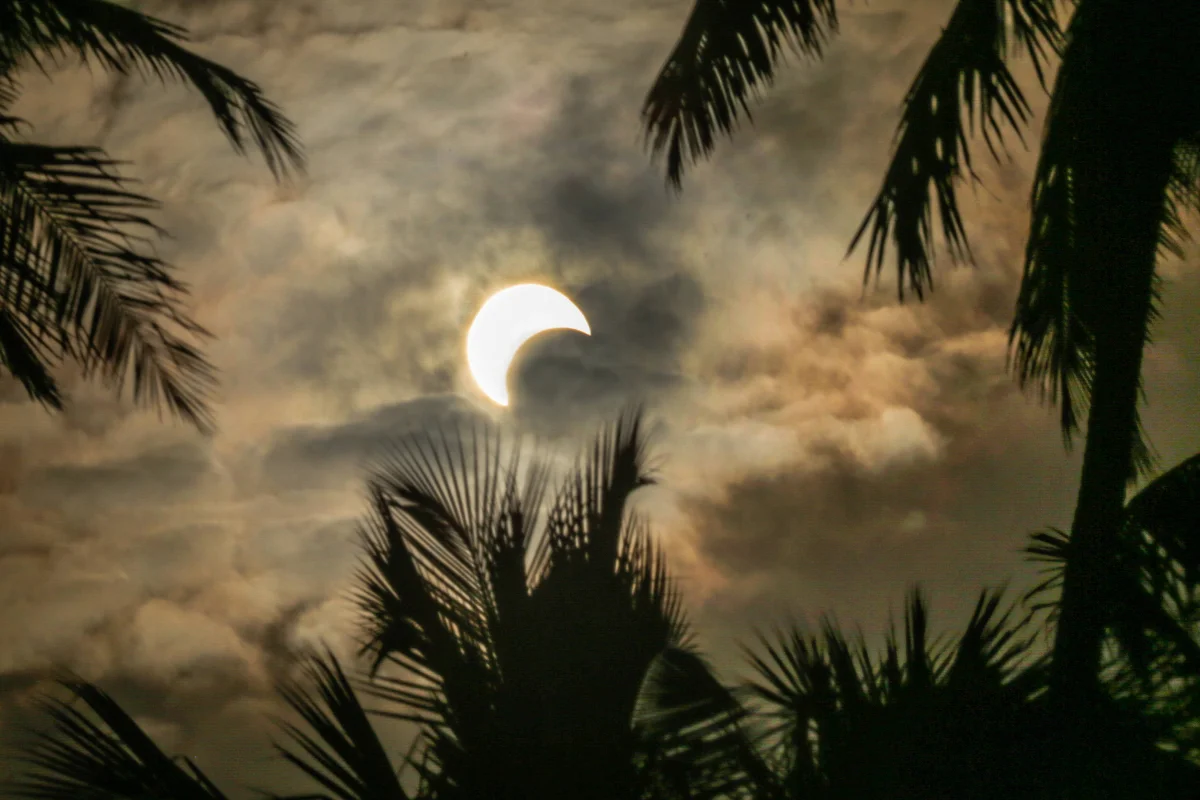
Before every eclipse, the internet fills with warnings: don’t go outside, don’t eat, don’t start anything important. It sounds like a piece of medieval advice, yet people really do report feeling unwell. So what is physics, what is psychology, and what is simply myth?
A solar eclipse is one of the few astronomical events people can notice without a telescope: the sky darkens in the middle of the day, temperatures drop, and birds fall silent. The experience is striking — and for centuries, those sensations have fueled the belief that an eclipse somehow “does something” to the body. But does it, or are we simply reacting to the sudden darkness?
What Happens Physically
A solar eclipse occurs when the Moon passes directly between Earth and the Sun, blocking the solar disk. A total eclipse lasts from a few seconds to 7.5 minutes — then the Moon moves on and daylight returns. Within the path of totality, which can be 100–270 kilometers wide, the sky becomes as dark as deep twilight, while air temperatures can fall by 3–5°C within minutes.
A partial eclipse — when the Moon covers only part of the Sun — is less dramatic: daylight dims but does not disappear, and without special glasses you might not even notice that anything is happening.
The Only Proven Danger Is to Your Eyes
This is the established and undisputed risk. Looking directly at the Sun during a partial eclipse, or during the phases immediately before and after totality, is dangerous for the retina. Infrared radiation, which the eye does not perceive as heat, can damage photoreceptor cells. The resulting condition, known as solar retinopathy, can lead to permanent vision impairment.
The paradox is that an eclipse actually encourages people to look at the Sun — something most people would never think of doing on an ordinary day. To observe it safely, you need special eclipse glasses (not regular sunglasses, which let through far too much light) or an indirect projection method, such as projecting the Sun’s image through a small aperture.
During totality, when the solar disk is completely covered and only the corona is visible, it is safe to look without a filter — but only for the brief period when the Sun is fully covered. The moment even a sliver of the solar disk reappears, eye protection is required again.
What About Blood Pressure, Headaches, and Anxiety?
This is where science and popular perceptions begin to diverge.
The internet contains descriptions of studies in which subjects allegedly experienced higher blood pressure, constricted blood vessels, or changes in blood flow in the brain’s hemispheres during an eclipse. Such findings are often cited without context.
In reality, there are no large, peer-reviewed studies in the scientific literature demonstrating a direct physiological effect of a solar eclipse on the human body.
Astronomer and Moscow State University physics professor Vladimir Surdin has pointed out that the very concept of an “eclipse corridor” has no scientific basis, while claims that eclipses affect human health are essentially superstition.
NASA, in a section devoted specifically to eclipse myths, states that a solar eclipse does not produce any special radiation, does not contaminate food, and poses no special danger to pregnant women. The only thing you need to protect yourself from is looking directly at the Sun.
Why Do People Still Feel That Something Is “Off”?
If an eclipse has no special physiological effect, where do the complaints come from? There are several possible explanations, and they all lie in the realm of psychology rather than physics.
-
The expectation effect
A person reads that an eclipse “affects your health” and starts paying closer attention to their body — noticing things they would normally ignore: a mild headache, fatigue, or anxiety. These sensations occur in everyone on a daily basis, but on an ordinary Tuesday, they simply don’t attract much attention.
-
An ancient instinctive response
Sudden darkness in the middle of the day is a powerful stimulus for the nervous system. For thousands of years, an eclipse was an unexplained and frightening event. We now understand what causes it, but the subconscious response to the disappearance of the Sun has not necessarily vanished.
A faster heartbeat, a slight rise in blood pressure, and a feeling of anxiety are not signs of illness, but a normal stress response to an unusual stimulus.
-
Changes in light levels
A sudden drop in light intensity over just a few minutes can temporarily disrupt circadian rhythms — the body’s internal clock, which is synchronized with the cycle of day and night. Animals tend to react more dramatically: birds fall silent, roosters start crowing, and nocturnal insects emerge. The effect is weaker in humans, but brief disorientation is possible.
The Temperature Drop Is the Only Clearly Measurable Effect
During a total eclipse, air temperatures within the shadow path really do fall — usually by 3–5°C over several minutes, and sometimes by as much as 8–10°C. Winds may weaken or change direction because cooling air behaves differently from heated air. Humidity can also rise briefly.
For people who are sensitive to weather changes, a sudden shift in temperature and atmospheric pressure can potentially trigger a headache or make them feel unwell.
But this effect is no different in principle from the body’s response to an ordinary cold front — except that it happens much faster and ends within minutes rather than over the course of a day.
Myths That Aren’t Supported by Evidence
1) “An eclipse affects you for two weeks before and after.”
No. Before and after an eclipse, the Sun shines as usual. The Moon blocks it for minutes, not a month. There is no such thing as “pre-eclipse radiation.”
2) “You can’t eat during an eclipse because the food becomes poisonous.”
No. NASA explicitly debunks this myth: an eclipse produces no special radiation capable of damaging food.
3) “Pregnant women shouldn’t watch an eclipse.”
No. The same rule applies to everyone: never look directly at the Sun without proper protection. Pregnancy does not add any special restriction.
4) “An eclipse causes earthquakes.”
No. The Moon’s gravitational influence is essentially the same during an eclipse as it is during an ordinary new moon (a solar eclipse is, in fact, a new moon with precise alignment along the Earth–Moon–Sun axis). Seismologists have found no evidence of a meaningful correlation.
What Does This All Mean?
A solar eclipse is an astronomical event, not a medical one. The only proven danger is eye damage from looking directly at the Sun without proper protection.
Everything else comes down to the expectation effect, subconscious anxiety triggered by sudden darkness, and a brief temperature drop that the body experiences much like an ordinary blast of cold air.
An eclipse is absolutely worth watching — it is one of the most spectacular natural phenomena accessible to humans. There is no reason to fear it. The one thing you need to bring is a pair of eclipse glasses. Everything else is superstition that may be thousands of years old, but that does not make it true.